Professional Tone in OET Letters: Genre & Style Explained
How to write in the right professional register for OET letters — the specific language patterns, recipient calibration rules, and common errors that determine your Genre & Style band.
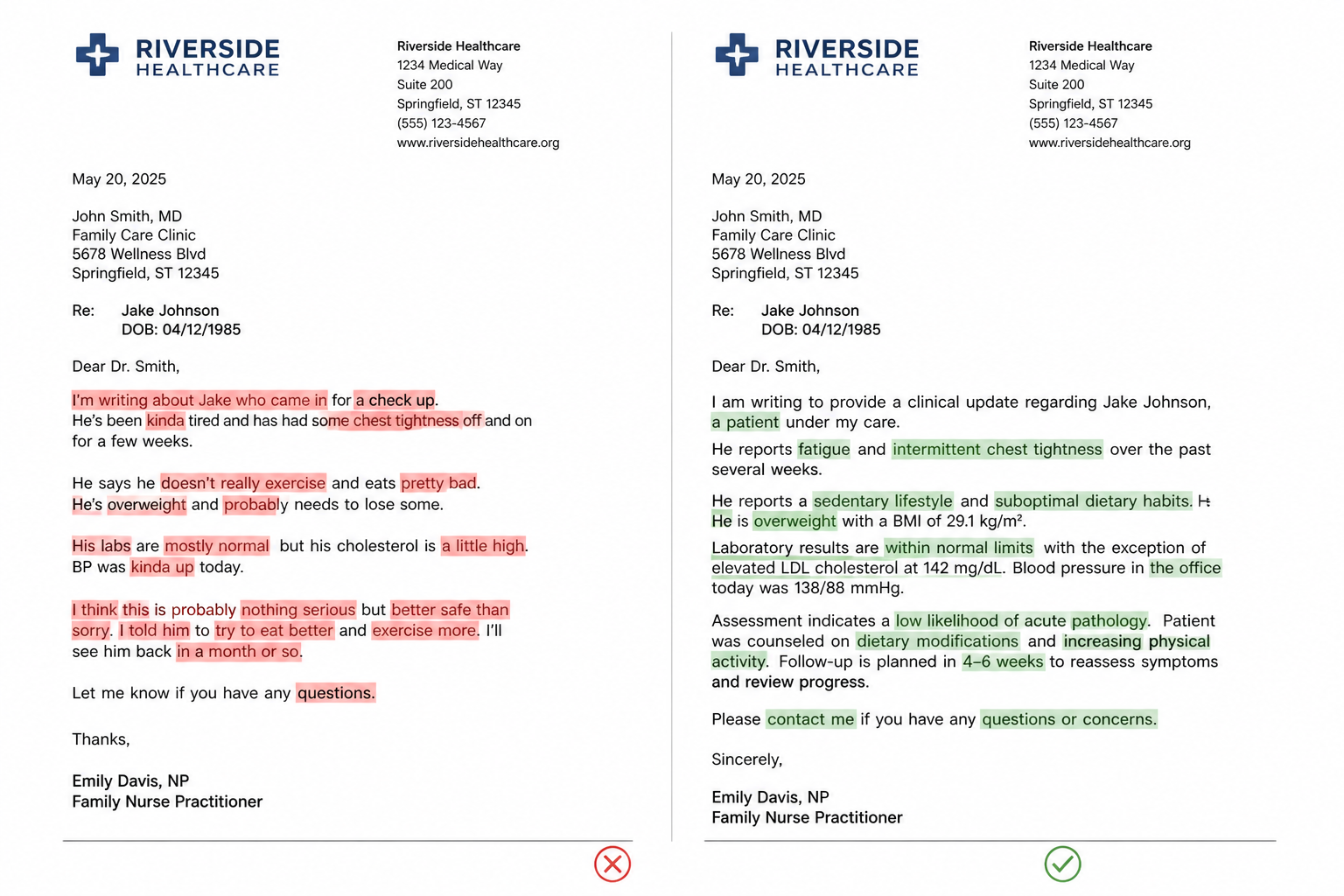
I have read more than 11,000 OET letters over 20 years. The single most common reason a B-level candidate plateaus at B rather than climbing to B+ is not vocabulary and not grammar. It is register. The letter sounds like a university essay, or worse, like a text message dressed up with formal words. Neither one is professional clinical correspondence, and Genre & Style is the criterion that catches both.
What Genre & Style actually measures
Genre & Style is one of the six OET writing criteria (Purpose, Content, Conciseness & Clarity, Genre & Style, Organisation & Layout, Language). Where Language covers grammatical accuracy and vocabulary range, Genre & Style covers something more subtle: does this letter read the way a real clinician would write it?
In practice, examiners are checking three things. First, whether you use the opening and closing conventions of professional correspondence. Second, whether your level of formality matches your recipient. Third, whether the overall texture of the letter belongs in a clinical setting or somewhere else entirely.
A letter can be grammatically flawless and still score a C on Genre & Style. Getting the register wrong is a structural problem, not a surface one.
The over-formal trap
Most candidates fall into one of two ditches. The first is over-formality: writing in the style of an academic essay or a formal government document.
You can spot this pattern by its connectors. “Furthermore”, “moreover”, “in addition to the aforementioned”, “it is hereby recommended that”. These phrases are appropriate in a research paper. They read as stiff and unnatural in a referral letter, and examiners recognise them immediately as a register mismatch.
The same problem appears in openings. “I am writing with reference to the above-named patient, who presented to our department on the date of…” is technically grammatical but needlessly bureaucratic. A real clinician writes: “I am writing to refer Mrs Nguyen, a 42-year-old female with a three-month history of unexplained weight loss.”
The under-formal trap
The second ditch is the opposite: letters that drift toward conversational or emotional language.
“I think she needs a scan” is too casual. “She was very worried and distressed about her symptoms” is emotional language that does not belong in clinical correspondence. “We noticed that his blood pressure has been a bit high” sounds like a chat between colleagues rather than a formal referral.
OET letters are professional documents. They describe, request, and recommend. They do not emote, speculate casually, or hedge apologetically.
Recipient calibration
The register also shifts depending on who you are writing to. This is where many otherwise strong candidates lose marks.
A letter to a GP requires more contextual background than a letter to a specialist, because the GP is not familiar with the fine details of your specialty. A letter to a specialist can use technical clinical terms without explanation. A letter to a patient or their family member needs plain English, a supportive tone, and no unexplained jargon.
Writing to all three recipients with the same language level is a Genre & Style failure even if the individual sentences are well-constructed.
Professional phrasing in practice
| Context | Non-professional (penalty risk) | Professional (correct register) |
|---|---|---|
| Opening | ”I am writing with reference to the above-named patient who has been under our care…" | "I am writing to refer Mr Hassan, a 54-year-old male with type 2 diabetes…” |
| Referral reason | ”Furthermore, it is our belief that further management is required." | "He requires further assessment and management of his deteriorating renal function.” |
| Requesting action | ”I am hoping that you can please review his medications if possible." | "I would be grateful if you could review his antihypertensive regimen.” |
| Describing symptoms | ”She was feeling very tired and she was very worried about her condition." | "She reports persistent fatigue and has expressed concern regarding her prognosis.” |
| Closing | ”I hope you don’t mind seeing her. Sorry to bother you with this." | "Thank you for accepting this referral. Please do not hesitate to contact me if you require further information.” |
| Hedging | ”I think maybe she might need further investigation if that is okay." | "Further investigation is warranted, including a chest CT and pulmonary function tests.” |
L1 transfer patterns to watch
Certain Genre & Style errors appear more often depending on your first language. Arabic-speaking candidates frequently use hyper-formal ceremonial phrasing: “I humbly request”, “I beg to inform you”, “please find enclosed herewith”. These constructions come from formal Arabic correspondence conventions. They read as archaic in an OET letter.
Filipino candidates often produce apologetic hedging: “Sorry to bother you”, “kindly please review”, “I hope this finds you well”. The politeness convention is culturally appropriate but signals the wrong register for clinical correspondence.
Candidates from Indian English backgrounds sometimes combine formal connectors with preposition errors: “as per your kind consideration”, “with reference to the patient admitted on yesterday”. The formal intention is correct; the specific phrases are not.
In all three cases, the underlying language competence is often strong. The Genre & Style error is a genre convention problem, not a proficiency problem. That distinction matters because convention problems are faster to fix.
Check your own letters first
Before submitting any practice letter for correction, run through it once asking: does every sentence sound like a clinician writing to a colleague? If you find a connector (“furthermore”, “moreover”), remove it. If you find an apology (“sorry to bother you”), remove it. If you find an emotional description (“she was very upset”), replace it with a clinical observation.
The free Writing Checker can flag register issues in seconds. For precise band-level feedback with written comments on every Genre & Style problem, a correction from our OET writing correction service gives you the specific line-by-line annotation you need to understand exactly what examiners saw.
If you want to see the Genre & Style criterion demonstrated in a real OET letter with worked examples, the Genre & Style video lesson walks through each register decision step by step.
Frequently asked questions
Common questions on this topic — full answers below.
What does Genre & Style mean in OET writing?
What register should OET letters use?
What are the most common Genre & Style errors in OET?
How does recipient calibration affect the Genre & Style band?
Which phrases should I avoid in OET letters?
How can I practise professional tone before the OET exam?
OET Writing Correction
Get expert OET letter feedback from Dr Mariam's team
Submit your practice letters and receive a detailed annotated PDF — assessed against all 6 OET writing criteria.
11,000+ letters corrected since 2014 · 4.9★ from 1,900+ reviews