How to Write an OET Letter
A comprehensive explanation of how OET letters are structured, the six OET writing criteria used by examiners at Cambridge Boxhill (the joint venture that runs OET), and common reasons candidates may lose marks despite strong language skills. Based on our experience correcting 11,000+ OET letters since 2014.

What the OET Writing Task Assesses
According to the official OET assessment criteria, writing focuses on professional communication skills rather than advanced linguistic complexity. The test is scored across six official criteria by trained assessors at Cambridge Boxhill (the joint venture that runs OET); the criteria are not equally weighted, with Purpose carrying fewer marks than the other five.
Case Note Interpretation
Accurate understanding of complex medical information
Information Selection
Appropriate content choices for specific audiences
Reader-Centered Writing
Clear professional communication for colleagues
Professional Register
Appropriate tone for clinical correspondence
How to Use Your 45 Minutes
The OET writing task gives you 45 minutes total. Most candidates underestimate planning and run into structural problems mid-letter. Below is the timing plan Dr Mariam's correction team recommends after correcting 11,000+ letters.
Read case notes (twice)
First read for clinical understanding. Second read to identify recipient, letter type, and purpose. Mark relevant information with a quick highlight.
Plan structure
Sketch a four-paragraph outline: opening (purpose), background (relevant history), current situation, request/closing. Decide what to include and — equally important — what to leave out.
Write the letter
Aim for 185–195 words. Don't pause to perfect a sentence — keep moving. Editing is faster than drafting under exam pressure.
Review and adjust
Check register stays professional throughout, tenses are consistent, opening states the purpose, and the closing has a specific action. Trim or add to hit 180–200 words.
Live Walkthrough: Case Notes to Grade B Letter
Below is the exact thinking process for turning a case-notes prompt into a Grade B referral letter. We start with the raw case notes and walk through each decision — selection, opening, body, closing — with the reasoning shown alongside the writing.
The case notes (what you receive in the exam)
Patient: Mrs Eleanor Mitchell
Age: 64
PMH: Type 2 diabetes (12 yrs), hypertension, mild osteoarthritis (knees)
Social: Lives with husband, retired teacher, walks daily
Presenting: 4-week history progressive R knee pain, now constant, disturbs sleep, reduced mobility
Examination: Reduced ROM R knee, mild crepitus, no swelling, BMI 29
Investigations: X-ray shows moderate-severe OA changes R knee
Mgmt to date: Paracetamol, ibuprofen, physio (limited benefit)
Plan: Refer orthopaedics for surgical assessment / joint replacement
Task: Write a referral letter to the orthopaedic surgeon, Mr Thompson, at the Regional Hospital.
Decide what to keep and what to leave out
Mr Thompson is an orthopaedic surgeon. He needs to know why this knee needs surgery now, the conservative measures already tried, and any surgical/anaesthetic risk factors. Everything else is noise.
- Age, knee pain timeline, current severity
- X-ray findings (severity of OA)
- Failed conservative management
- Diabetes, hypertension, BMI (anaesthetic relevance)
- Functional impact on daily life
- "Retired teacher" (irrelevant to surgical decision)
- "Walks daily" — replace with functional impact
- Husband (not surgically relevant)
- "Mild osteoarthritis (knees)" as PMH — the knee IS the referral, not background
Draft the opening sentence
Three openings, with reasoning:
"Mrs Eleanor Mitchell is a 64-year-old woman with knee pain."
Loses marks: states a fact, not a purpose. The reader doesn't know this is a referral.
"I am writing to refer Mrs Mitchell."
Adequate but thin: states the action, but not for what or why. Examiner has to read further to understand the case.
"I am writing to refer Mrs Eleanor Mitchell, a 64-year-old woman, for orthopaedic assessment regarding right knee osteoarthritis that is no longer responding to conservative management."
Grade B opening: action (refer), patient identifier, age, specialty, condition, and clinical justification — all in one sentence. Examiner knows the case in 12 seconds.
Write the body — chronological clinical order
Two paragraphs: timeline of the knee problem, then surgical-relevance comorbidities.
Background paragraph: Mrs Mitchell has experienced progressive right knee pain over the past four weeks, which has now become constant and is disturbing her sleep. Her mobility has been significantly reduced, and previously enjoyed daily walking is no longer possible. Examination reveals reduced range of movement and mild crepitus, with X-ray confirming moderate-to-severe osteoarthritic changes.
Comorbidities paragraph: Her medical history includes well-controlled type 2 diabetes of twelve years' duration and hypertension. Her BMI is 29. Conservative management with paracetamol, ibuprofen, and a course of physiotherapy has provided only limited symptomatic benefit.
Note how the first paragraph is the patient story and the second paragraph is the surgically-relevant background. This is what "logical organisation" means in OET — themed paragraphs, not chronological listing of every fact.
Write a closing with a specific request
"Thanks for your help."
Loses marks: conversational and contains no clinical request.
"In view of her failed conservative management and the radiological findings, I would appreciate your assessment for consideration of joint replacement surgery. Please do not hesitate to contact me if you require further information."
Grade B closing: recapitulates the rationale, names the specific intervention, and offers professional follow-up.
The final assembled letter (188 words)
Dear Mr Thompson,
I am writing to refer Mrs Eleanor Mitchell, a 64-year-old woman, for orthopaedic assessment regarding right knee osteoarthritis that is no longer responding to conservative management.
Mrs Mitchell has experienced progressive right knee pain over the past four weeks, which has now become constant and is disturbing her sleep. Her mobility has been significantly reduced, and previously enjoyed daily walking is no longer possible. Examination reveals reduced range of movement and mild crepitus, with X-ray confirming moderate-to-severe osteoarthritic changes.
Her medical history includes well-controlled type 2 diabetes of twelve years' duration and hypertension. Her BMI is 29. Conservative management with paracetamol, ibuprofen, and a course of physiotherapy has provided only limited symptomatic benefit.
In view of her failed conservative management and the radiological findings, I would appreciate your assessment for consideration of joint replacement surgery. Please do not hesitate to contact me if you require further information.
Yours sincerely,
Dr GP
This letter would score Grade B (370–390 range). To push it to Grade A, the body paragraphs could be slightly more concise and the comorbidity-to-surgical-risk link could be made more explicit ("with implications for anaesthetic planning and perioperative glycaemic control").
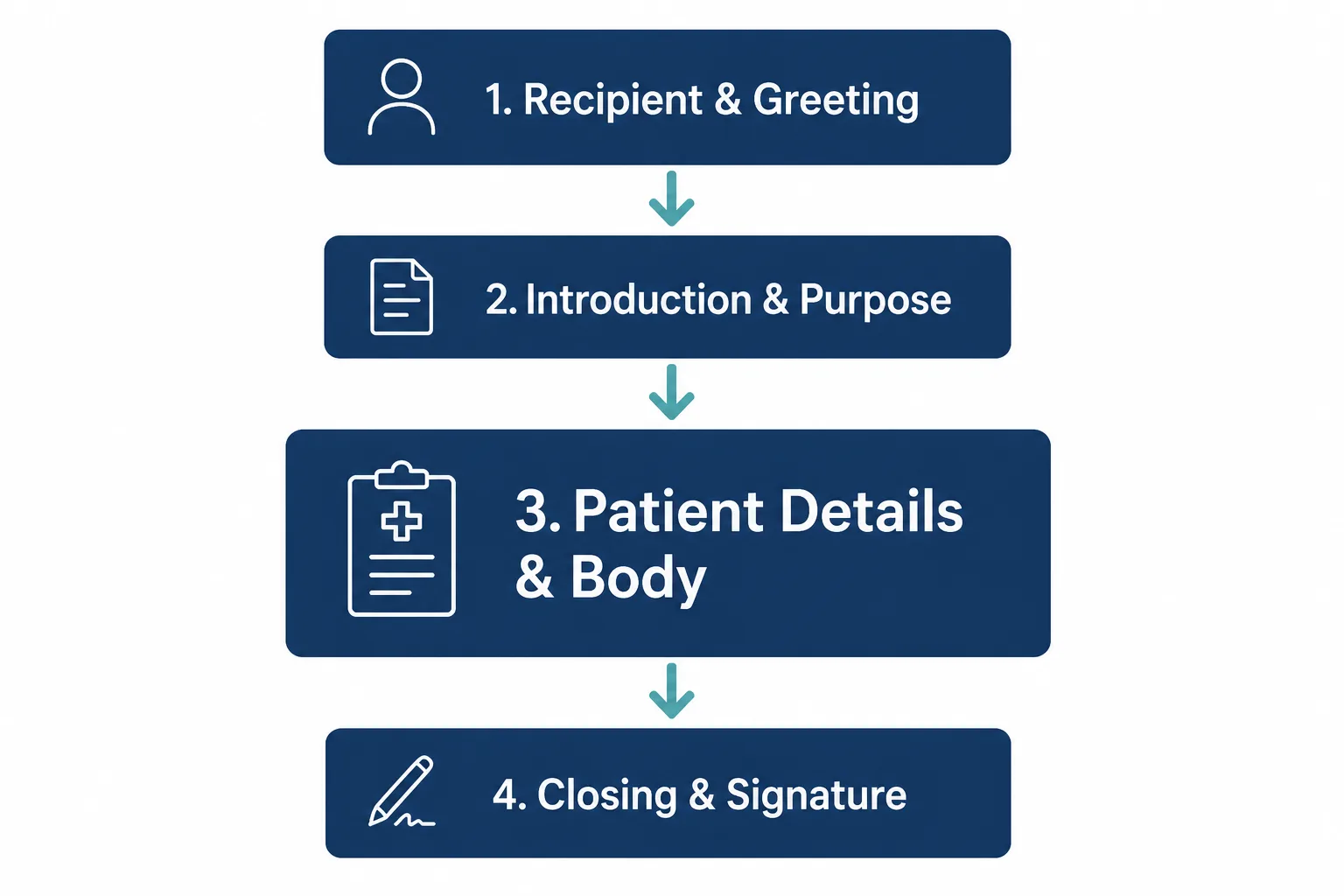
Standard OET Letter Structure
Clear purpose statement
Establish the reason for writing immediately.
Relevant clinical background
Include pertinent patient history for context.
Current clinical situation
Present recent findings or status changes.
Specific request or recommendation
State clearly what action is needed from the reader.
Professional closing
Conclude with appropriate contact information.
Letter Type Variations
The structure above applies to every OET letter. The differences between letter types are mainly in the opening verb and the action requested in the closing.
Referral letter
"I am writing to refer..."
Asks the recipient to assess, treat, or take over a clinical aspect.
See dedicated guideDischarge letter
"I am writing to inform you that... has been discharged..."
Hands over ongoing care and lists follow-up actions.
See dedicated guideTransfer letter
"I am writing to request the transfer of..."
States destination, urgency, and clinical reason.
See dedicated guideAdvice letter
"I am writing to provide guidance on..."
Gives clear instructions and a safety net.
See dedicated guideFrequently Asked Questions
How long should an OET letter be?
How much time should I spend on each part of the OET writing task?
Should I copy phrases directly from the case notes?
What is the most common reason candidates fail OET writing?
Should I write the letter in formal or informal English?
Related guides: OET writing criteria · OET writing test format
Stop Guessing. Get Examiner-Style Feedback.
Reading guides only takes you so far. The fastest way to Grade B is detailed feedback on your own letters from teachers trained in the OET assessment criteria.
Want an expert's eyes on your OET letters? Dr Mariam's OET writing correction service marks every letter against all six OET writing criteria and returns line-by-line corrections within 24–72 hours.
See how it works